

Single-Product Focus Doesn't Work in the AI Age
It's time to rethinking product strategy dogma

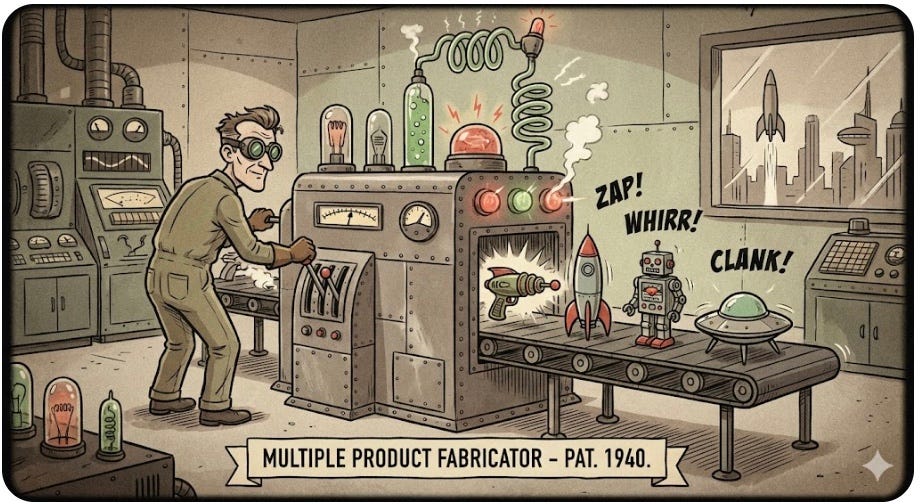
There’s advice that gets handed down to founders like scripture: pick one thing, nail it, don’t get distracted. It made sense for a long time. It doesn’t anymore—at least not in AI and data companies.
The companies winning in this space don’t look like single-product boutiques. They look like engines: data architecture plus infrastructure plus AI that can ship multiple products off the same base. That’s not a lack of focus. That’s the whole point.
Where the dogma came from
The one-thing rule emerged when products were physical or tied to specific distribution channels. Each new line meant factories, sales teams, capital expenditures. Software moved slowly. Integrations were brittle and expensive. In that world, diversification usually meant split attention, bloated org charts, and the dreaded “conglomerate discount” from investors.
So single-product focus hardened into dogma.
But modern data and AI companies don’t operate under those constraints. Infrastructure is elastic and composable. Data is reusable across problems. AI is a general-purpose capability, not a single feature. Treating all that as fuel for exactly one offering means deliberately surrendering leverage.
Three shifts that changed the math
First, cloud and APIs. You don’t build new infrastructure for each product anymore. Auth, billing, logging, ML pipelines—they’re shared. A second or third product doesn’t require new plumbing.
Second, data compounds. Every integration, customer, and event stream makes the whole dataset more useful. Once the domain model is right, marginal cost for the next product is mostly design and packaging.
Third, AI is generalized capability. Once you’ve invested in data pipelines, training, evaluation, and deployment, that stack powers dozens of prediction and decision use cases. The question isn’t “what’s our one product?” It’s “given the infrastructure we’re building anyway, how many problems in this domain can we profitably solve?”
Big tech already proved this
Before looking at AI-native companies, note that big tech disproved the single-product rule years ago.
Amazon started as an online bookseller. It could have stayed laser-focused on retail. Instead, it productized its logistics as Fulfillment by Amazon, its payments as Amazon Pay, and its IT infrastructure as AWS. What began as internal cost centers became massive profit centers that now underwrite the economics of the whole business.
Google and Microsoft followed the same arc. Google exposed the systems built for Search and Ads as Google Cloud, then layered on Maps APIs and AI services. Microsoft turned its infrastructure into Azure and tied it to Office, GitHub, and its AI stack. They didn’t stay focused on “just search” or “just Windows.” They stayed focused on owning leverage points—data, infrastructure, platforms—and monetizing them multiple ways.
Data as compounding asset
Most organizations treat data like fuel for one-off projects. Extract, clean just enough, feed a dashboard or model, move on. Repeat for the next initiative.
In an AI-native company, data behaves more like compound interest. Every new integration makes existing data more powerful. Every customer mapped into the same model improves predictions across the vertical. Every metric and feature becomes reusable once it’s grounded in proper semantics.
The compounding happens when you have a stable domain model—shared entities, events, relationships—and pipelines, models, and apps all reference that model instead of inventing bespoke schemas. Then the first product is expensive, the second is cheaper, and the tenth is mostly configuration.
That’s the difference between good and great data companies. Good ones treat data as project fuel. Great ones treat it as a compounding asset by investing in durable domain architecture.
From custom ontologies to vertical-universal ontologies
Palantir is the clearest example of taking this seriously. In Foundry, an ontology serves as the core semantic layer: raw data mapped into business objects, their properties, and the relationships between them. Pipelines, models, and apps are defined in terms of business concepts—orders, aircraft, patients—not raw tables.
Palantir builds this ontology per enterprise. For governments and large industrial firms, that custom modeling is worth it. But it’s also expensive and services-heavy.
The next step, and where many AI/data companies should aim, is moving from custom ontology per customer to vertical-universal ontology per domain. SignalFlare.ai (full disclosure: I’m a founder and CEO) takes a page from Palantir’s playbook but applies it differently. Instead of building custom ontologies per client, we’ve built a universal domain ontology and data architecture for the restaurant industry. The entities, events, and relationships that matter—locations, transactions, labor, promotions, trade areas—are modeled once and reused across the vertical. That creates efficiencies Palantir’s per-enterprise approach can’t match in a fragmented industry with thousands of operators. Instead of one ontology per client, you build one robust ontology for retail networks, or logistics, or healthcare claims. Each customer maps their systems into that shared model, adds local fields and quirks, and uses modules that already understand the domain.
When that architecture is right, 80-90% of the heavy lift—modeling, cleaning, mapping—is the same across customers and products. The remaining 10-20% is localization. The ontology becomes a reusable vertical asset. Every deployment strengthens it instead of forking it.
One spine, many products
Vertical SaaS follows a parallel pattern with less noise. A restaurant platform starts with POS, then adds payments, payroll, and labor optimization once it sits in the middle of every order and shift. A commerce platform starts with storefronts, then adds payments, credit, and logistics once it sees every transaction.
The hard part—integrating messy systems and normalizing the domain—is done once. Additional products are different ways to monetize that asset.
Internal tools are future products
To ship even one “simple” product, you inevitably build connectors, transformations, quality checks, monitoring, feature logic, model infrastructure, and admin tools. In the single-product mindset, these are cost centers supporting the “real” app.
In reality, they’re exactly the pain points your customers face. They’re often 70-80% of what a dedicated infrastructure company would sell. Slack started as an internal tool for a failed game. AWS was internal infrastructure pain turned into cloud revenue.
If you never ask whether an internal capability is itself a product, you’re voluntarily staying smaller than your own work.
Why single-product dogma is actively dangerous
In AI and data, “just focus on one thing” introduces specific risks.
You cede the moat to someone else. If you only own the last mile—UI, thin app—but not data integration, governance, or model lifecycle, you’re dependent on whoever owns those layers. Vulnerable when they move up-stack and compete.
You under-monetize your hardest work. Integrations, data modeling, reliability, and governance are usually the most expensive parts of the business. If those stay internal costs while you only charge for a narrow app, you’re subsidizing others who do turn similar capabilities into products.
You give up compounding benefits. With vertical-universal architecture, every new customer enriches the domain model, every use case sharpens shared features, and new products are easier because hard work is reused. With bespoke schemas per project, every new thing feels like a rebuild.
You can’t take full advantage of AI at the edges. Tools now generate full-stack apps from natural language. That’s powerful—if the underlying data is coherent. If your semantics are messy, AI just builds faster on the wrong assumptions. If your ontology is solid, AI-generated apps plug into a stable model, and you can iterate on last-mile experiences safely.
What focus should actually mean
The answer isn’t “do everything.” It’s redefining focus around the right axis.
Focus on a domain, not a single persona or feature. Be ruthless about which world you model—retail, logistics, healthcare—but don’t limit who can benefit. A robust retail supply-chain ontology can serve retailers for optimization, insurers for underwriting, logistics providers for routing, and SaaS vendors for forecasting.
Focus on the ontology and platform first. Your real v1 is the vertical data model and pipelines that support many use cases. The first app is just the wedge. It’s not the company.
Focus on reusability. Assume serious internal tools are potential products if the problem recurs, the solution is generic within the domain, and it strengthens the shared ontology. Build them as reusable capabilities, not one-off hacks.
Focus on adjacencies that reuse 80-90% of the stack. Every new SKU should use the same domain model, same infrastructure, same ML backbone. If a new idea can’t reuse most of your stack, be skeptical. If it can, it’s a leveraged extension, not a distraction.
The new reality
In the old playbook, the ideal startup was a sharp, single-feature spear. In AI and data, winners look more like compounding machines: vertical-universal ontology, predictive models bound into that semantic layer, and a portfolio of products and APIs on top.
To traditional product teams, this is uncomfortable. More moving parts. Less comfort in one clean roadmap. Lines blurred between platform and product, internal and external tools.
But that’s the point. The companies that matter in this wave turn cost centers into profit centers, internal tools into platforms, and messy fragmented data into durable compounding assets.
That’s not a lack of focus. That is the focus.