

The Human Connection Premium
Why Some Businesses Can Charge More

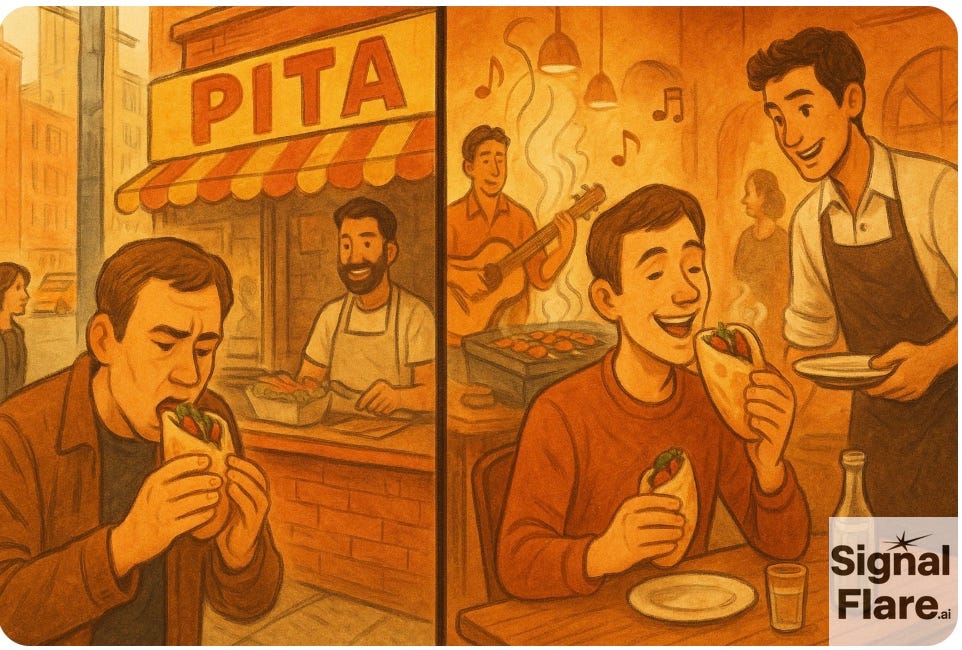
Why does Blue Bottle charge $4 for coffee while the gas station charges $1.50?
Value = Quality of Experience / Price
The difference isn’t just in the product—it’s in the experience. And the most powerful driver of experience quality is human connection. That connection is the most reliable differentiator between a commodity and something people will pay a premium for.
What Human Connection Actually Measures
Human connection isn’t about being friendly or having good customer service. It’s measurable through specific indicators:
Recognition: Do they remember you or your preferences?
Personalization: Is the interaction adapted to you, or is it a script?
Problem resolution: When something goes wrong, does someone care enough to fix it?
Emotional stake: Does the person serving you have any investment in whether you leave satisfied?
A regular customer who feels recognized will pay 20-30% more than someone who doesn’t. That’s pricing power.
The Components of Food Service Experience
Food service engages all five senses—taste, smell, touch, sound, and sight work together to shape emotion and memory. The hum of conversation, the scent of roasted coffee or seared steak, the feel of linen, the warmth of lighting—all reinforce how humans connect through shared sensory experience.
Three components determine the quality side of the value equation:
1. Service
Service ranges from self-service to white glove attention, but the real variable is human connection.
At the low end, you interact with no one or follow a script with someone who has no stake in your experience. At the high end, someone anticipates your needs, remembers your preferences, and solves problems before you notice them. Two restaurants with identical service mechanics can have completely different perceived value depending on whether servers are going through motions or actually care whether you’re enjoying yourself.
2. Food & Beverage Quality
This is the most commodity-like component. Ingredient quality, taste, texture, presentation—these are tangible and comparable. A grocery store steak versus a prime cut at a steakhouse.
But there’s a perception element beyond pure commodity value. A chef who understands flavor composition creates something worth more than the sum of ingredients. And menu language shapes what customers think it’s worth. “Grilled chicken breast” versus “herb-marinated free-range chicken with lemon and thyme” sets different price expectations for materially similar dishes.
The commodity value of food creates a floor. You can’t charge fine dining prices for cafeteria-quality food. But superior ingredients alone don’t justify premium pricing—otherwise grocery stores would be price on par with fine dining.
3. Atmosphere
The physical environment: lighting, temperature, sound levels, smells, textures, spatial layout. Food service is distinctive because it engages all five senses simultaneously.
Are you on a terrace overlooking the ocean with salt air and waves? Or on a busy street corner with diesel fumes and screeching tires? The same meal in different atmospheres has different perceived value. Atmosphere is part of what you’re buying.
Atmosphere also amplifies or diminishes the other components. Great service in a poor environment feels wasted. Mediocre service in a beautiful space feels disappointing.
The Restaurant Math
Here’s how these three components scale across price tiers:
Fast food: $8 per person
Service: Self-service or scripted interaction. Little human connection. Transactional only.
Food quality: Consistent, adequate. Engineered for reproducibility and cost, not flavor complexity.
Atmosphere: Bright lights, hard surfaces, designed for turnover not comfort. Functional.
Value equation: adequate food in functional space / low price = acceptable value.
Casual dining: $25 per person
Service: Table service with some personalization. Server knows the menu, can handle substitutions, might remember repeat customers. Moderate human connection.
Food quality: Higher ingredient quality, more complex preparations, better flavor composition. Menu descriptions create perception of value.
Atmosphere: More comfortable seating, controlled lighting and sound, intentional design. Pleasant but not distinctive.
Value equation: better food + comfortable environment + some human attention / moderate price = good value.
Fine dining: $150+ per person
Service: Highly attentive, personalized, anticipatory. Server knows your preferences, chef adapts to your taste, staff remembers special occasions. Maximum human connection.
Food quality: Premium ingredients, sophisticated technique, complex flavor compositions. Menu language reinforces exclusivity and craft.
Atmosphere: Carefully orchestrated sensory environment. Every detail—temperature, lighting, acoustics, scent, spatial flow—is intentional.
Value equation: exceptional food + orchestrated atmosphere + deep human connection / high price = premium value.
The food quality might be 3x better at the fine dining restaurant, and the atmosphere 5x better, but you’re paying 20x more. That gap is the human connection premium. It’s the only component that scales enough to justify the price difference.
Managing Value with Decision Intelligence
Most businesses don’t measure human connection, so they can’t see when it’s eroding. They track revenue per square foot, average transaction size, cost per customer acquisition—all lagging indicators that tell you what happened, not what’s creating value.
From a Decision Intelligence perspective, human connection is often the missing input in pricing and operational models. Businesses optimize for easily measurable factors like cost per unit, inventory turnover, and labor hours while ignoring the factor that actually drives willingness to pay.
A proper DI framework measures the leading indicators of human connection and experience quality:
Service Component Measurement
Repeat visitation rates and frequency changes
Customer engagement levels during visits
Staff-customer interaction patterns and duration
Problem resolution speed and effectiveness
Purchase Pattern Analysis Modern point-of-sale and ordering systems capture detailed behavioral data. Which items are ordered together? How do recommendations affect basket size and satisfaction? What modifications do regulars consistently request? This reveals preferences that enable personalization at scale.
Feedback Integration Structured feedback (surveys, ratings) and unstructured feedback (social media, review text) both matter. The structured data shows trends. The unstructured data shows why. A DI system that monitors both can identify which specific touchpoints create or destroy value.
Recognition Technology Anonymized facial recognition can improve throughput, enable better recommendations, and track repeat visitation without requiring customers to identify themselves. A system that recognizes you’re a regular can prompt staff to offer your usual order or suggest variations based on your taste profile. This creates the feeling of being remembered without friction.
Personalization at the Point of Service Customer data platforms linked to DI systems can match taste profiles to recommendation engines. A kiosk that suggests better ingredients based on your previous orders creates more value than one that just upsells “make it a combo.” The difference: one enhances your experience based on what you actually like, the other is generic revenue optimization.
This same capability in the hands of servers is even more powerful. A server with access to your taste profile and previous visits can make genuinely helpful suggestions rather than reciting specials. The technology enables the human connection—it doesn’t replace it.
What Actually Gets Measured A DI framework optimized for experience value tracks:
Customer lifetime value segmented by engagement level
Willingness to pay premium (measured through price testing and purchase patterns)
Correlation between specific service interactions and return rates
Impact of personalized recommendations on satisfaction scores
Revenue retention when discounting is removed
These metrics reveal whether customers are connected to your business or just transacting. They show which investments in human connection actually create pricing power and which are ineffective.
With these measurements in place, you can make intelligent decisions about where to invest. Which touchpoints create the most connection value? Which staff behaviors correlate with higher repeat rates? Where does technology reduce friction and where does it create distance?
Most businesses allocate resources based on cost minimization. DI frameworks optimized for experience value allocate resources based on connection maximization. The technology handles routine tasks. The people focus on the high-impact interactions that create pricing power.
Conclusion
Of the three components that create experience value—service, food quality, and atmosphere—human connection is the least commoditized. Food quality can be replicated. Grocery stores sell the same ingredients restaurants use. Gas stations sell adequate prepared food. Atmosphere can be copied—chains prove this by replicating environments across hundreds of locations. But genuine human connection isn’t scripted, but company culture can make it a core & sincere part of the brand experience.
This is the fundamental difference between a restaurant and a gas station. Both sell food. The gas station might even have decent coffee and fresh sandwiches. But no one goes to a gas station for the experience. There’s little human connection, so it’s closer to a pure commodity transaction.
Restaurants that strip out human touchpoints to cut costs are actively converting themselves into gas stations. They’re competing on the same terms: convenience and price. They lose the most sustainable differentiator they had.
The businesses with real pricing power understand that technology should enable more human connection, not less. Use technology for routine and repetitive tasks—order taking, payment processing, inventory management, scheduling. This frees people to focus entirely on hospitality and genuine engagement. A server who isn’t worried about memorizing orders can pay attention to whether you’re enjoying your meal. A host who isn’t manually managing reservations can focus on making guests feel welcome.
Measure human connection, invest in it, and use technology to amplify it. That’s where pricing power comes from. That’s the human connection premium.